Why Your Battery-Powered Device Flickers Off Before It’s Actually Dead
By Nick Kowalski
Have you ever noticed a battery-powered device turn off, turn back on, then turn off again as its battery gets low? It’s a typical behavior of low-cost battery-powered devices, and it isn’t a fault in the device itself. It’s the battery protection circuit reacting to something called cell polarization.
In this article, we’ll explain what cell polarization is, why it causes that on/off flicker with conventional lithium battery modules, and how we designed Battery Pal to avoid it.
Why Does My Device Turn On and Off at Low Battery?
The vast majority of lithium battery modules use fixed protection ICs like the DW01 or BQ2970x. These chips disconnect the cell when its voltage falls below a factory-set undervoltage threshold. The catch is that, because of cell polarization and IR drop, the voltage the protection IC measures is never the cell’s true voltage. So with a conventional fixed-threshold module, you almost always end up in one of two cases:
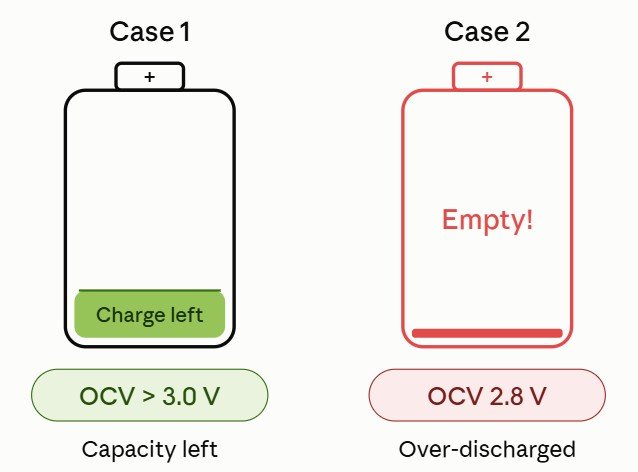
Case 1: The true OCV (open-circuit voltage) of the cell is still well above the cutoff, but under load the voltage sags below the protection threshold and the output shuts off. With the load gone, the cell relaxes back up to its OCV, the protection IC releases, the device turns back on, sags again… and you get on/off cycling while there is still usable energy left in the cell.
Case 2: The OCV of the cell is already very low when the protection finally trips, because the cutoff was set low enough to avoid Case 1 under heavy loads. At light loads there is almost no sag, so the cell gets drained much deeper than it should, which shortens its cycle life.
Neither outcome is great, and a single fixed threshold can’t avoid both. To see why, we need to look at what’s happening from the protection IC’s perspective.
Cell Polarization and Under Voltage
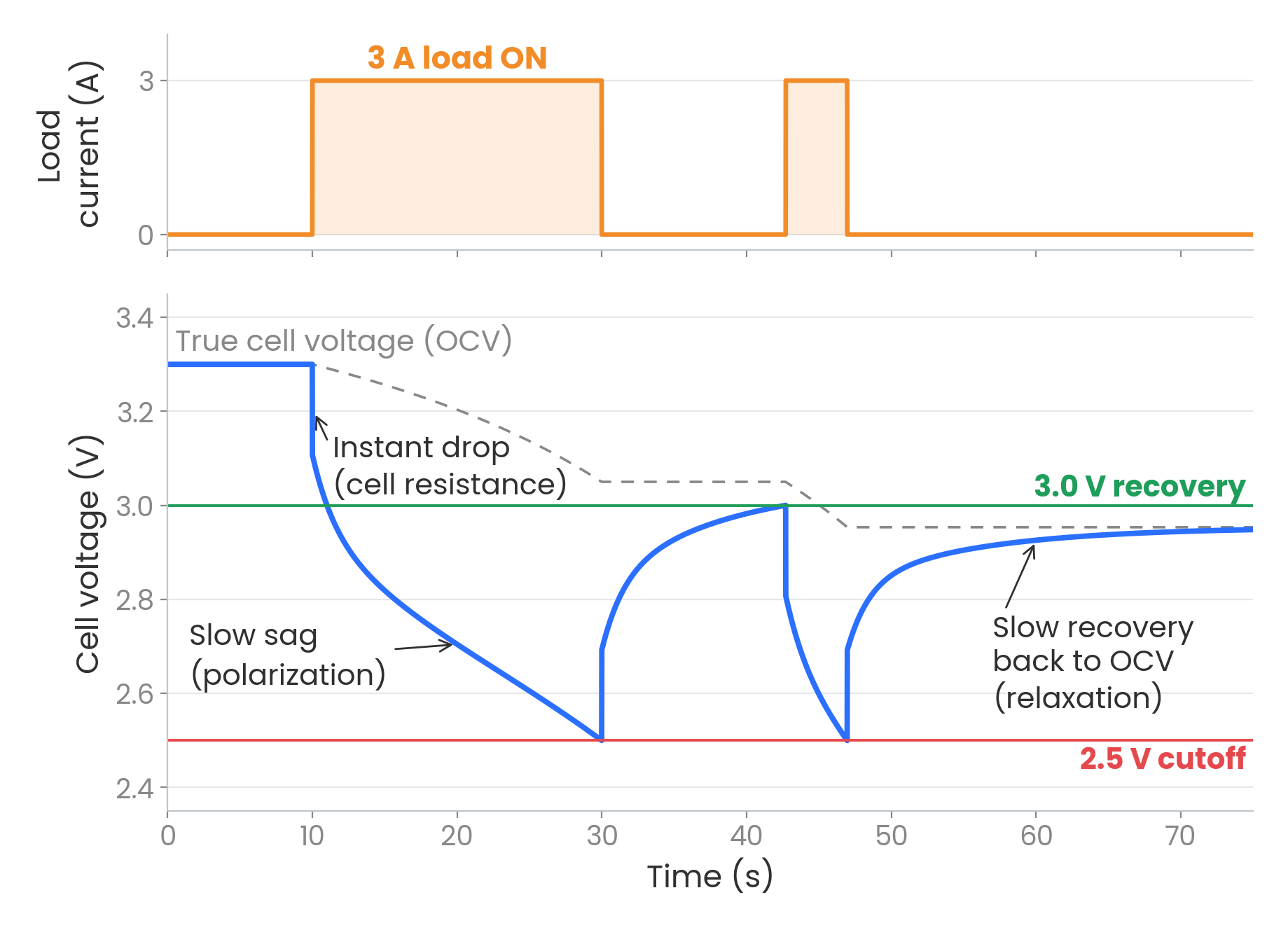
The voltage you measure at a lithium cell’s terminals only matches its true voltage (OCV) when no current is flowing and the cell has had enough time to reach equilibrium. As soon as a load is connected, the measured voltage drops below it. The graph below shows what that looks like on a nearly empty cell with a typical fixed protection IC:
1. The load turns on: The voltage drops instantly because of internal resistance, then keeps sagging as the 3 A draw continues. This slow, growing gap between the measured voltage and the true cell voltage is polarization.
2. The protection trips: The measured voltage hits 2.5 V and the protection IC cuts the output, even though the true cell voltage is still above 3.0 V.
3. The cell recovers: With no current flowing, the voltage jumps back up and then slowly creeps toward the true cell voltage. Once it passes 3.0 V, the protection releases and the load turns back on.
4. It trips again, faster: The cell never fully relaxed, so it sags to 2.5 V again within a few seconds. This time it settles just under 3.0 V, so the output stays off for good.
From the outside, your device just flickered off and on before dying, and it cut out the first time while the cell still had usable energy left.
How Battery Pal Avoids This
Battery Pal uses the BQ27Z746 from Texas Instruments. On top of being a precision 16-bit fuel gauge for accurate battery percentage readings, it’s also an I²C-programmable protection IC with adjustable over/undervoltage, overcurrent and temperature thresholds.
That lets you avoid both cases above entirely:
- Tunable undervoltage threshold: Set the UV cutoff to any value down to 2.0 V based on your expected load and wiring length, so heavy loads don’t trip it early and light loads don’t over-discharge the cell.
- Latch-off on undervoltage: Configure the protector to shut off as soon as your threshold is reached and stay off until a charger is plugged in, regardless of what the OCV rises to.
Will I have to write my own firmware?
No! Every Battery Pal will come pre-configured for a standard 3.0–4.2 V lithium cell and works without you uploading any firmware. To change the settings and view the chip status live, you’ll be able to use our web app, which is currently in development.
Take a look at our pre-launch page here!